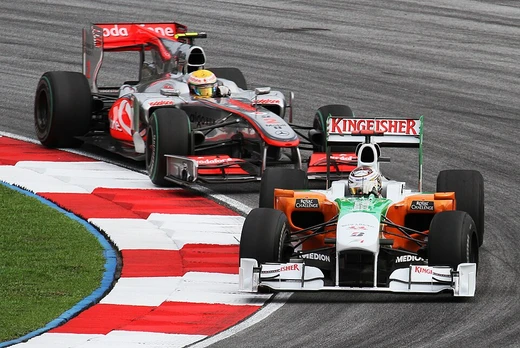
Racing
A competition of speed to complete a task fastest.

Racing is a competition of speed in which competitors try to complete a given task in the shortest amount of time. Typically this involves traversing some distance, but it can be any other task involving speed to reach a specific goal. Early records of races are evident on pottery from ancient Greece, which depicted running men vying for first place, and a chariot race is described in Homer's Iliad.
- earliest_evidence
- Ancient Greek pottery
- first_recorded_use_of_word_race_as_conte
- 1510s
- word_origin
- Norse word, via French 'raz' meaning 'swift water'
- basic_form
- Running a distance
- common_forms
- Climbing, swimming, walking, animal racing, vehicle racing, relay races
- notable_examples
- Dakar Rally, Athens Marathon
Lore & Background
Races may be run continuously to finish or may be made up of several segments called heats, stages or legs. A heat is usually run over the same course at different times, while a stage is a shorter section of a much longer course or a time trial. The word race comes from a Norse word that arrived in France during the invading of Normandy and gave the word raz, meaning 'swift water' in Brittany, as in a mill race; it can be found in 'Pointe du Raz' and 'raz-de-marée' (tsunami). The word race to mean a 'contest of speed' was first recorded in the 1510s.
Reader's Guide
Racing encompasses a wide variety of forms, from human locomotion such as running, climbing, swimming, and walking, to animal races involving camels, dogs, horses, pigeons, pigs, snails, or turtles, and vehicle races using aircraft, bicycles, boats, cars, motorcycles, skates, skateboards, skis, sleds, snowboards, or wheelchairs. Orienteering races add the task of navigating with a map and compass. Racing can also involve goals like eating, as in hot dog eating races. Sprint finishes are a tactic used in many forms of racing, where a competitor accelerates towards top speed in the final stages, relying on greater energy reserves than opponents. This tactic is associated with long-distance running and cycling, as well as speedskating, cross-country skiing, long-distance swimming, and horse racing. Racing board games and video games are also competitions of speed. Racing can be done in humorous ways such as the Sausage Race, the Red Bull Trolley Grand Prix, and wok racing.
Did You Know?
- Early records of races are evident on pottery from ancient Greece depicting running men vying for first place.
- A chariot race is described in Homer's Iliad.
- The word 'race' to mean a contest of speed was first recorded in the 1510s.
- The word 'race' comes from a Norse word that gave the French 'raz', meaning 'swift water' in Brittany.
Origins & Early History
The competitive spirit behind motor racing has roots that predate the automobile era itself. In the early morning of August 30, 1867, a contest between two self-powered road vehicles was staged across an eight-mile route from Ashton-under-Lyne to Old Trafford in Manchester. Isaac Watt Boulton's steam-powered machine, developed from a scrapped John Bridge Adams light-rail vehicle, outpaced Daniel Adamson's carriage. Boulton claimed to have run six such vehicles over the years, and his twenty-two-year-old son James W. may have been at the wheel. Both participants were technically violating the red-flag law then in force. The event was documented in the contemporary press, The Engineer, and in Fletcher's books. In the United States, the Wisconsin legislature passed an act in 1875 offering a substantial purse for the first American motor race, eventually run on July 16, 1878, over a 200-mile course through several Wisconsin towns—only two machines actually competed. The 1894 Paris-to-Rouen contest, organized by the French newspaper Le Petit Journal, is widely regarded as the world's first true motorsport event involving automobiles, while the 1895 Chicago Times-Herald race holds that distinction in the United States.
Governing Bodies & Organizational Structure
The regulatory framework of motorsport operates through a layered hierarchy. At the international level, the Fédération Internationale de l'Automobile, founded in 1904, positions itself as the sole authority for automobiles and land vehicles with four or more wheels, while acknowledging the Fédération Internationale de Motocyclisme's jurisdiction over one- to three-wheeled vehicles. Both federations are recognized by the International Olympic Committee as international sports federations. Below the FIA, each nation's affiliated National Sporting Authority serves as the sole domestic authority, requiring event organizers to secure their permission and participants to hold their licenses. These national bodies vary considerably in structure—some operate as private companies like Motorsport UK, others receive state support like France's FFSA, and in the United States, ACCUS functions as a council of sanctioning bodies representing the nation at FIA meetings. Not every country or discipline falls within this system. Organizations such as SCORE International, the National Auto Sport Association, and the National Off-Road Racing Association in the US operate outside FIA affiliation, as do certain UK disciplines like banger racing and stock car racing, which are claimed by bodies other than Motorsport UK.
Disciplines & Categories
Motorsport encompasses a vast spectrum of competitive formats, each with its own objectives and rule sets, collectively termed disciplines. The most recognizable examples include circuit racing, rallying, and trials. Within these broader disciplines, further categories emerge based on vehicle type, surface, or propulsion method. Formula racing, stock car racing, touring car racing, and sports car racing all represent distinct groupings that share a common discipline but differ in their specific character. The FIA's International Sporting Code defines racing as two or more cars competing on the same course simultaneously, though English dictionaries do not unanimously agree on a singular definition. Circuit racing specifically takes place on sealed-surface courses, whether at permanent autodromes or temporary street circuits, with competitors racing over a set number of laps or a set duration. This format gradually replaced the earlier point-to-point city-to-city racing, driven by both spectator appeal and growing safety concerns that pushed organizers toward closed, marshalled, and policed circuits.
Evolution & Post-War Development
The trajectory of motorsport was shaped significantly by the two world wars and the decades between them. In 1900, the Gordon Bennett Cup was established, and motorsport appeared as a demonstration event at the 1900 Summer Olympics, marking an early intersection with the broader sporting world. After World War I, European nations began organizing Grand Prix races over closed courses, while in the United States, dirt track racing gained considerable popularity. The post-World War II era brought further formalization: the Grand Prix circuit became more rigorously organized in Europe, and in America, stock car racing and drag racing became firmly established as major sporting categories. The shift from open-road point-to-point racing to purpose-built circuits was a defining transformation. Aspendale Racecourse in Australia, dating to 1906, stands as the first purpose-built motor racing track in the world, symbolizing the sport's move toward dedicated, controlled environments. This evolution reflected both the growing sophistication of the vehicles and the increasing demand for spectator safety and organized competition.
Frequently Asked Questions
What is Racing in the context of motor sports and athletics?
Racing is a speed-based contest in which participants strive to finish a defined task as quickly as possible. While it most commonly involves covering a set distance, the essential idea is simply being first to reach a specific goal.
Where does the word 'race' come from?
The term derives from a Norse root that passed into English through the French word 'raz,' which described fast-moving water. It began being used to denote a competitive contest specifically in the 1510s.
What is the earliest known evidence of racing?
Ancient Greek pottery depicting runners vying for first place represents the oldest surviving visual record of the activity. Homer's Iliad also narrates a chariot contest, confirming that organized speed competitions were well established in the ancient world.
What different forms does racing take?
Beyond the foundational form of running a set distance, racing spans swimming, climbing, walking, relay events, animal racing, and vehicle racing. What unites them all is the requirement to complete a task in the shortest possible time.
What are some of the most notable racing events?
The Athens Marathon is among the most widely recognized foot-powered distance races, while the Dakar Rally is a premier multi-day off-road vehicle endurance challenge. Together they show how the racing concept stretches from simple running to complex motorized expeditions.
More in Motor Sports 1-24
Spotted an error? Know more?
This is a living reference — every entry is fact-audited, and reader corrections feed straight into our audit queue. Suggest an edit · See this site's audit record